The Graveyard Book Read Along

Stainless Steel Droppings has the schedule up! Hooray! This is a fun reading event featuring one of my favorite books. If you want to play along, it is not too late – head over to Stainless Steel Droppings to sign up. This read along is part of the larger event R.eaders I.mbibing P.eril in which readers can pick a variety of levels to challenge one’s self – and I am surprised how much of my reading material fits into the parameters of this reading event! Who knew I read so much dark fantasy, crime, mystery, etc. With this read along, there are two additional mini-events that you can read about at the end of Stainless Steel Droppings’ post.

This will be a re-read for me, having read The Graveyard Book a few years ago. I contemplated doing the audio version (read by Neil Gaiman himself), but I find it difficult to stop at the correct place – I have a tendency to press on and with this book I could see myself finishing it easily in a few sittings (it’s that entertaining). So I will be reading along in my trusty paperbook, bookmark in hand.

In Carl’s words:

Read Chapters 1-3:

How Nobody Came to the Graveyard
The New Friend
The Hounds of God

from October 1st through October 6th. Post your thoughts on these chapters on Sunday, October 7th.

Read Chapters 4-6:

The Witch’s Headstone
Danse Macabre
Interlude: The Convocation
Nobody Owens’ School Days

from October 8th through October 13th. Post your thoughts on these chapters on Sunday, October 14th.

Read Chapters 7-8:

Every Man Jack
Leavings and Partings

from October 14th through October 20th. Post your thoughts on these final chapters/the book on Sunday, October [21st].

The Bastard of Istanbul by Elif Shafak

Why I Read It: I liked the cover and because it was written about a culture I not very familiar with.

Where I Got It: paperbackswap.com

Who I Recommend This To: Those who enjoy coming of age and connecting with the past stories.

Narrator: Laural Merlington

Publisher: Tantor Media (2007)

Length: 12 hours 39 minutes

This is a modern day fiction set mostly in Istanbul. The story starts off following Zeliha, 19, and her trip to the abortion clinic. Then we jump to Arizona where we follow a recently divorced Kentucky transplant women, Rose, and her year old baby girl, Armanoush. Jump ahead roughly 20 years, and Zeliha’s daughter Asya is a strong willed women that has been raised by a gaggle of aunties and no men. Her father is never mentioned and the only male relative, uncle Mustafa, lives in America married to a plump blonde wife. Armanoush, an Armenian-American, divides her time between her mother’s place in Arizona and her Armenian family in San Fransisco. The bulk of this book is about these two young ladies; one seeks answers about her past and the other treats her past as dead and buried.

Elif Shafak built these characters with distinct voices and it was so very easy for me to picture Asya stuck at the dinner table with her well-meaning nagging aunties asking about her ballet class. Armanoush flew to Istanbul on a whim and it was nice to see that she had certain assumptions (incorrect though they turned out) about Turkish culture. I could see myself making the same mistakes. This book was by turns serious and funny, touching and exasperating, and has been the spark for me to explore Turkish and Armenian cuisine.

Laural Merlington did an absolutely fantastic job – with humor and sadness, male and female voices, and most of all accents – from Turkish and Armenian words/names to a Kentucky accent. I would not hesitate to listen to another book narrated by her.

What I Liked: The entire atmosphere captured in this book; nearly all female cast of characters without being feminazi-ish; Auntie Banu and her captured djin; Johny Cash got lots of play time in Istanbul; the ending was a bit tough but gave closure.

What I Didn’t Like: Some of the minor characters had long-winded designators instead of names and at times it became tedious to hear them repeated multiple times in one passage.

The Little Stranger by Sarah Waters

Why I Read It: The Estella Society was hosting a read along.

Where I Got It: The Library

Who I Recommend This To: Ghost-story lovers who like a slow build up with lots of nuance.

Narrator: Simon Vance

Publisher: Books on Tape (2009)

Length: 13 CDs

I enjoyed this book from the beginning because of Simon Vance’s voice, a narrator I have been enthralled by on several books. I became captivated by the story because of Sarah Waters‘ nuanced take on a gothic-style ghost story. In fact, if I did not know from the beginning this was a ghost story, this tale would have been a historical fiction in my mental categorization for nearly all of the book.

The story follows Mrs. Ayres and her two grown children Caroline and Roderick through the eyes of our story narrator Dr. Faraday. Each of the main characters has some loss and some deep-seated longing and those two things drives the flaws in them. Set in post-WWII Britain, Hundreds Hall has gotten quite dilapidated. The Aryes can’t admit to themselves or their peers what financial conundrums keeping the place is putting them in. So they struggle on with a part-time cleaning lady and a slip of a girl servant, with Roderick making house repairs and Caroline helping out with the cooking. They both milk the cows.

Dr. Faraday comes from working-man stock and through perseverance on his part and great sacrifice by his parents completed medical school to become a country doctor. In many ways, he straddles the two main classes of society – the working, uneducated poor and the landed nobility. The tale starts off with him as a small child sneaking peaks at a magnificent party at Hundreds Hall while his mother performs her function as a servant. The bulk of the story takes place later in life (Dr. Faraday is in his 40s) and due to his roots and his education he finds that he is welcome few places as anything more than a doctor.

This book kept me riveted during my commute and on days when I didn’t commute, I often thought of reasons to run a few errands just so I would have time and opportunity for this book. I truly enjoyed the slow buildup of the mystery; were all the unfortunate and abnormal incidents at Hundreds Hall due to some paranormal force or aberrant human behavior? This book kept me guessing to nearly the end. I also liked how there was some ambivalency to the ending, leaving it up to the reader to decide one way or the other. In short, this book made me think, and we all know I like a good think.

Simon Vance, as always, was a welcome voice on my ears. His word pronunciation is clear and his pacing excellent. I love how he imbues the written word with an undercurrent of emotion. Once again, The Little Stranger was a quality performance.

What I Liked: Easily read as a historical fiction or ghost story; the portrayal of the class differences was deeply interesting to me; none of these characters are superb heroes or supermodels – they are all flawed in some way; the reader had to pay attention and think throughout the book to make a decision about the ending.

What I Disliked: At a certain point, Roderick has to go off for medical treatment and we as the readers see very little of him afterwards – I think I would have liked a bit more of his presence in the book.

Read Along Part I

Read Along Part II

Not only was this book part of a read along, I also read it as part of Stainless Steel Droppings’ R.eaders I.mbibing P.eril event (and I would dual categorize this book as Gothic and Supernatural). It’s not too late for you to play along, so check out Stainless Steel Droppings for details.

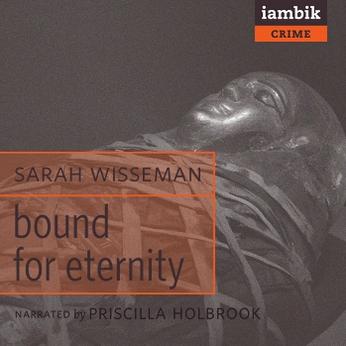
Bound for Eternity by Sarah Wisseman

Why I Read It: I love mysteries with a archaeological/ museum bent.

Where I Got It: From the publisher through Audiobook Jukebox (thanks!)

Who I Recommend This To: If you enjoy the mysteries of Elizabeth Peters, who’ll probably enjoy this modern-day sleuth.

Narrator: Priscilla Holbrook

Publisher: Iambik Audio (2012)

Length: 6 hours and 29 minutes

Series: Book 2 in The Lisa Donahue Mysteries

An ancient mummified mystery gets wrapped up in a modern day tangle of death in this Boston crime fiction. I enjoyed this book from the beginning. Lisa Donahue is a widowed mother and is currently on as a probationary hire competing for a permanent position as curator with the Boston University Museum of Archaeology and History.

See, that right there was enough to have me wanting to read this book. Call it a mystery fetish: I like things going down in museums. And Sarah Wisseman must have known this and hence set out to entertain me by creating this series of books (I believe there are currently 4 in print). Even though this is Book 2 in the series, it read just fine as a stand-alone mystery.

Lisa, the narrator of the story, and sleuth of ancient and just-yesterday mysteries is so real because she worries about her job, her kid, her friends, and her love life. She makes mistakes and tries to fix the ones that matter. In this mystery, we have one dead child mummy, and we start off pretty quickly with a dead museum worker. The cop keeps things close to his chest (like he should, as a professional) and Lisa blunders around a bit putting several clues together before she hands them over to the police. I liked this aspect because that is how it is in the real world – you pull the string tracking something down and eventually realize that it could be tied to a major crime and smack yourself in the head for not turning the whole headache over the authorities sooner. The mystery itself had me bouncing between 2 suspects until near the end. Once it became apparent to me as the reader who was the evil-doer, said person behaved within character in attempting yet another murder.

As a sideline to the main conundrum, Lisa also has her romance life to figure out. James the Doctor enters the scene and he is everything a woman could want – successful, sensitive, a widower father, good with kids, and available. If this story has a main character flaw, it is that James was without flaw, and hence, without character depth. But I was able to overlook this as I wanted some tranquility for Lisa, who is stuck in a difficult job situation as a single parent and with the added pressure of having her coworkers knocked-off on a regular basis. Overall, this was an entertaining read.

Priscilla Holbrook gave us accents from the East coast and did a believable job on male voices. I found it easy to listen to her narrate this book primarily in Lisa’s voice. If the audio had a flaw, it was with the variation in audio level; it was never enough so that I had to adjust my settings, but it occurred throughout the book.

What I Liked: Mummy murder mystery; main character has flaws; good people don’t have to have the same morals as you (such as dating the boss); museums are the place to be.

What I Disliked: James The Boyfriend was pretty one dimensional.

Not only was this book read for it’s mummy-ness, I also read it as part of Stainless Steel Droppings’ R.eaders I.mbibing P.eril event (fulfilling the category of Mystery). It’s not too late for you to play along, so check out Stainless Steel Droppings for details.

Owl Dance by David Lee Summers

Why I Read It: A good chunk of this book takes place in the desert Southwest, like my life so far.

Where I Got It: Courtesy PDF ARC from the author (thanks!)

Who Do I Recommend This To: If you like your genres all mixed up with steampunk, cowboys, & attempted military take-overs, then this is for you.

Publisher: Flying Pen Press (2011)

Length: 270

Series: Book 1 (I hope, with reason – see author’s Web Journal)

In David Lee Summers seventh novel, Owl Dance, he explores the American Southwest in a crazy 1800s Wild West Steampunk adventure. This was the perfect brain candy for me and diving into the first chapter, I felt right at home. Ramon Morales, a Mexican-American sheriff, and Fatemeh Karimi, a Persian healer, are our two main heroes. Throughout their travels across NM, AZ, and CA, they come across a variety of delightfully unexpected characters – from the gun-slinging kid Billy to entrepreneurial scientist Maravilla, to the California Coast inventor-turned-pirate Cisneros, to General Sheridan.

Ramon and Fatemeh have to avoid several trips and falls of life, such as being burned at the stake, or killed by miners, or shot, or blown up, or captured by bounty hunters. But their greatest challenge doesn’t come from the Southwest. No, there is something much more ominous brewing in Mother Russia. A land dispute between resident Russian descendants in CA and a powerful rancher sparks off the drive for Russia to grab some land in the American West. But this time, they are aided by an unlikely source…..which I will leave for you to discover.

Clockwork wolves and owls, cutting edge submersibles, dirigibles, and one Persian lady who whistle-talks to owls. It’s a great ride. If you’re looking for a good read and satisfying adventure, jump into Owl Dance.

What I Liked: Multi-cultural book; alternate history is always fascinating; a touch of steampunk never goes amiss; owl- whistle talking.

What I Disliked: Pretty much just 1 main female character surrounded by lots of male main characters.

Note: This review was originally published on Darkcargo.com on 11/22/2011 and republished, and reformatted, here with permission of Lady Darkcargo.

The Little Stranger Read Along Part II

Welcome back all to the second, and concluding, part of the read along of The Little Stranger by Sarah Waters. Once again, this most awesome pick was the choice of the folks of The Estella Society, so make sure to wander over there and sample their take on this book.

The Little Stranger Read Along Part I

There Be Spoilers! You have been warned.

OK. So, everyone has some tragedy haunting them in this book. Dr. Faraday never met the woman of this dreams and had a family; Caroline is so plain and ordinary, she couldn’t really hope to attract a love match and once she had found a place in life as a war nurse and escapes her family, she got called back to nurse her injured brother; Mrs. Ayres lost her first child, daughter Susan, to diphtheria and found that she never loved anyone quite the same again; Roderick had his war accident that left him scarred and a little crippled.

So, with that as our starting point, this old once-majestic house seems to be haunted. At first, we can’t tell whether or not there is an actual paranormal presence or merely a variety of abnormal human behavior. In fact, this book had me flip-flopping back and forth until the end. I loved that about the story. There’s the eerie little fires that eventually lead up to a true midnight nuisance that almost kills Rod and is the final straw that sends him and what little is left of his psyche off the mental hospital. Next, the servants and Caroline are plagued by calls at the most inconvenient times followed by the summoning bells and whistles (those noisemakers used to summon servants to any part of the house to carry light-weight objects from one side of the room to another). This silly game finally culminates in Mrs. Ayres in the old nursery, trapped behind a locked door, desperately wanting out, breaking the glass on the window, and ending up severely lacerated. Throughout it all, Dr. Faraday maintains that there is nothing with ectoplasm running about the house. He maintains this when even greater tragedy occurs – Mrs. Ayres taking her own life.

As the story moves forward, Dr. Faraday and Caroline become engaged. Yet, it is such a hesitant engagement on Caroline’s part – she shows no interest in the arrangements, the clothes, the date, the decorations, the food, etc. Granted, she has grief and hardship on her mind. The family was in financial straights before Rod went off to the institution and the house was gloomy and sad before the tragedy with Mrs. Ayres. So it wasn’t until somewhere in the last 2 CDs that I started to really worry for Caroline – Why wouldn’t she marry? If she doesn’t marry, what will happen to her and Hundreds Hall? Would Dr. Faraday’s heart be irrevocably broken and would he make a scandal and fuss over it?

But then Caroline becomes the hero of the story, flying in the face of then societal expectations. She makes the momentous decision to sell Hundreds Hall and leave the country, possibly planning to go to the Americas. Awesome! Oh, but she won’t be marrying Dr. Faraday, and in fact never loved him, just kind of had it all muddled up inside her head. All this only like 2 weeks before the wedding. I think my heart broke a little bit for Faraday over that scene. Still, Caroline had it right in that marrying out of gratitude and staying at Hundreds Hall could have ended up being the greater tragedy.

So let’s talk about that ending. Caroline dies on what was to be her wedding night in an empty house, falling from an upstairs landing as Betsy the servant watches in surprise and dismay. Faraday spent that night in his car, in that lonely still glade where he and Caroline parked and had the most regrettable first tryst. He yearned so greatly for the life he was to have with Caroline – living at Hundreds Hall chief among them. Of course, there was the legally required inquest in which her death was ruled a suicide while she was not herself. After that, the rumors fly about the Hall being haunted. This leads to difficulties with it selling and it becomes even further run down. Faraday is the only one who visits the Hall on a regular basis, tending to it as he can.

The ending lets the reader decide if there was a phantasm, or ghost, or spiritual energy and I admire the craftsmanship that went into this novel. For me, I believe the unexplained and unfortunate events were the work of Faraday’s deep longing to be a part of Hundreds Hall. I also like how that kind of ending gives symmetry to the story: Faraday is a firm believer in the tangible and science and not in the paranormal.

So, what say you?

Do you believe that our deepest yearnings, hopes, dreams, wishes, and prayers can affect the world around us? Perhaps even manifesting unknowingly in a negative manner to get what we desire?

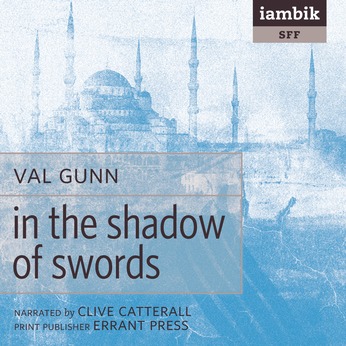
In the Shadow of Swords by Val Gunn

Why I Read It: Assassins and Legendary Books – Who could pass this up?

Where I Got It: Review copy from publisher (thanks!)

Who I Recommend This To: Need a fast-paced fantasy set in an medieval Arabic world? Then this is for you.

Narrator: Clive Catterall

Publisher: Iambik Audio (2011)

Length: 10 hours and 14 minutes

Series: Book 1 in series

This book was a treat, full of intrigue and the quest for vengeance. Val Gunn provided a lush background for his murderous spies and devious assassins to carry out their deeds. Marin isn’t just an accomplished tracker, spy, and sword-swinger, but also a grieving widow. She wants a man’s head on a spike, and not just any man’s. Hiril Altair has a djin curse upon him that makes it impossible to resist his master’s bidding. But he wasn’t bidden to fetch the Legendary Books of Promise. Tsk, tsk…..This sets up the story for lots of conflict, and sharp-tongued remarks tinged in dark humor.

In a world of ghuls and other demon-spawned beasties, these humans must muddle through for my entertainment. And I was indeed mightily entertained. In fact, when this book ended, I was tempted to give it another go. The sequel isn’t out there yet, which is a bit of a (calculated?) torture. The beasties were real beasties, slaughtering without concern for age or gender or armament. Some of the descriptive scenes of destruction and death really drove home the darker side of this tale.

Clive Catterall was the perfect voice for Hiril Altair, our main assassin, providing a somewhat gravely, world-weary voice. He also did a decent female voice for Marin. His character voices were distinct for each person. Just a note here: When I had a snag with an incomplete track, I contacted Iambik and it was fixed in less than 24 hours. Excellent customer service response.

What I Liked: Lots of action; a touch of horror; strong female character; not based in a European fantasy land; no one gets exactly what they want in the end.

What I Disliked: Only 1 main female character; I had a little trouble keeping the cast of characters straight as I had difficulty imagining how to spell some of the names.

I am counting this as a Dark Fantasy for Stainless Steel Droppings’ R.eaders I.mbibing P.eril (which is a lot of fun and you can still play along if pop over there).

The American Way of Eating by Tracie McMillan

Why I Read It: I am perpetually fascinated by industrialized food.

Where I Got It: The library.

Who I Recommend This To: If you enjoyed Michael Pollan‘s  or Morgan Spurlock‘s works, this would be another good book for your shelf.

Publisher: Scribner (2012)

Length: 319 pages.

In this non-fiction account of America’s long-standing love affair with quick and easy food, Tracie McMillan takes us on an unbiased ride through grape fields, store produce departments, and the food assembly lines of sit-down chain restaurants. In each case, she took the time to live alongside those she worked with, struggling on a minimum wage (or less) paycheck.

I enjoyed this book mostly for the look at the migrant workers that are employed to harvest the majority of produce that fills our grocery stores. McMillan spent time harvesting grapes (having to remove the unacceptable ones), garlic harvesting, and peach picking. In each instance she was one of the few females and the only Caucasian; her Spanish came in very handy. Moving from there to being employed at Walmart in the produce department, I was surprised to learn that the Produce Manager had no real training or knowledge in fruits and veggies (such as shelf life and how best to store what). At Applebee’s, she worked in the kitchen on the finishing line, ensuring the plates of food looked pleasing and had all the correct accoutrements. Essentially, food was assembled in the kitchen, nearly all of it having been pre-processed (some of it to the point where it needed just to be heated before going to a customer).

One of the many things that I learned from this book was that organic crops can be sprayed with organic pesticides, insecticides, and fungicides. This seems to be going against the purpose of labeling something ‘organic’. Basically, this book reinforced my belief that unless you grow it and cook it yourself, you don’t truly know what you are getting. While this was a great informative book, there were certain spaces in which the story lagged, being filled with statistics.

What I Liked: Information dump; unbiased reporting; the author’s dedication to live alongside those she’s working with; this book increased by Spanish vocabulary; this was my introduction to the term ‘food desert’.

What I Disliked: Sometimes the stats became too much for me – I need numbers to have a frame of reference to have any meaning for me.

The Little Stranger Read Along Part I

Hello everyone. Welcome to the read along of The Little Stranger by Sarah Waters. This read along is the brainchild of those lovely, quick-tongued, and highly entertaining folks over at The Estella Society, so make sure to stop by and enjoy their site. As stated on their site, this is kind of a loosey-goosey read along, aiming for the midpoint today (Sept. 10th) and to be completed Sept. 17th. As of posting this, I haven’t seen a midpoint post at The Estella Society. If I see one go up, I’ll put in a direct link to it as we wouldn’t want to miss the fun. (P.S. the midpoint post went up Sept. 11th).

This is my first time reading anything by Sarah Waters. Her clear writing style and knack for including small mysterious or quaint detail drew me in straight off. The Little Stranger is set in rural Warwickshire, England, post  World War II. We first meet Dr. Faraday as a young boy sneaking peaks at a fancy party at Hundreds Hall where his mother works as a maid. The story then moves forward ~30 years or so and Hundreds Hall has faded greatly in grandeur. The Ayreses (Caroline, Rodney, and their mother) try to keep the place up with their own hard work.

I decided to check the audioversion, read by Simon Vance, out from the library. There are 13 discs and I am on Disc 7. Without spoiling any of the story, I just wanted to chitchat about a few points that have made this story interesting so far.

1) Rodney and Caroline are adult children and, based on their physical efforts to keep up Hundreds Hall, perfectly employable. So I had to wonder why at least one of them didn’t go get a job? Can that truly be any less ‘noble’ than milking the cows or doing the cooking? And the answer simply, is Yes. Based on the time and culture, it would have been next to unthinkable for landed nobility to go out and get an office job, rubbing elbows with the unwashed masses. Truly, the family would have been ostracized from high society. Yet, how it is now, the family rarely has peers over (due to the dilapidated state of their Hundreds Hall) and rarely are invited out by their peers (again, what would they wear?).

2) I love how the author made Caroline a sensible woman and very plain in appearance instead of making Caroline a financially poor belle of the story. I found myself relating to her from the first few encounter with her. I love how she cleans, gathers berries, milks cows, and cooks. She is also practical in footwear and her lack of stockings for day-to-day antics.

3) Based on this book being part of Stainless Steel Droppings’ R.eaders I.mbibing P.eril, I am guessing there is a supernatural element to this story. Yet, as the reader, being ~halfway through, I am still not positive. I am thoroughly enjoying how the author has woven the story so that all unfortunate events to this point can be described by abnormal human behavior.

4) Class difference keeps raising it’s ugly head. The story is told through the eyes of Dr. Faraday, a man whose parents poured everything they had into his education and who himself has worked hard to obtain and maintain his local practice. While his profession is often referred to as noble, there are still the small societal slights, on both sides, concerning him spending so much time with the Ayreses. I find this interesting as it is not something I personally have bumped into, having spent most of my life in the desert Southwest USA.

For those of you reading along, or having read Sarah Waters’ works before, what has drawn you in? What has kept you hooked?

Emperor: The Field of Swords by Conn Iggulden

Why I Read It: Books 1 & 2 were excellent, and I love this time period.

Where I Got It: paperbackswap.com

Who I Recommend This To: Roman Empire enthusiasts, and Gaulish warriors aficionados.

Publisher: Dell Books (2005)

Length: 594 pages

Series: Emperor Book 3

Once again, Conn Iggulden has kept me up late, distracted at work, and spouting Roman marching commands in my sleep. Naughty author. Book 3 picks up right where Book 2 left off, with Julius Caesar in Gaul, conquering as far as he can see through battle and road building. Marcus Brutus is still his right-hand man, Octavian grows into a very capable horseman and soldier, and Marc Antony becomes a growing presence in Julius’s life. Back in Rome, Crassus and Pompey must match wits and resources with some less-than-savory rising powers of the city, Milo and Clodius.

So far in the series, I think this is the best novel. Iggulden switches smoothly between the two main locations, but also smoothly between the main characters, showing the rift building between Caesar and Brutus over years, the friendship growing between Marc Antony and Julius, the wrangling back and forth (with mutual respect) between Crassus, Caesar, and Pompey. I also like how the cultural arrogance of the Romans was captured: The mighty civilized Romans bringing trade, roads, light, and civilization to the heathen Gauls. Iggulden does this without passing a judgement on the rights or wrongs of the supposed moral superiority of the Romans, but simply telling it in context. The interactions with Vercingetorix, king of the Gauls, were true to form.

There’s plenty of action and intrigue to move this story forward, but it is well balanced with insights into the motivations of the characters and nuggets about life at that time. While there are few ladies and all of them secondary characters, Servilia (Brutus’s mother), Alexandria (the goldsmith), and Julia (Caesar’s daughter), they have full lives and depth of character.

What I Liked: Straight-forward writing; character-building; the way Caesar absorbed Gauls into his armies; Pompey and Crassus have to learn to rule Rome without Caesar; left in a bit of cliff-hanger (looking forward to next book).

What I Disliked: No main character women.